

Mindful eating is all about paying full, non-judgemental attention to the experience of eating and drinking. It’s not another diet; it's a way of reconnecting with your body's natural hunger and fullness signals. Essentially, it helps you shift your relationship with food from something automatic to something intentional.
Defining Mindful Eating Beyond the Buzzwords
Have you ever finished a meal while scrolling on your phone, only to look down and realise you barely tasted a single bite? That’s mindless eating in a nutshell, and it’s an incredibly common habit in our fast-paced world. Mindful eating is the complete opposite. It's about switching off that autopilot setting and bringing all your senses to the table.
Here’s an analogy: mindless eating is like having music on in the background while you work—it’s just noise. Mindful eating, on the other hand, is like putting on a good pair of headphones, closing your eyes, and truly listening to your favourite album, noticing every note and lyric. The music hasn’t changed, but your experience of it has, completely.
This practice encourages you to tune in to the entire experience of eating—what’s happening inside and outside your body. It means eating slowly, savouring the flavours, and actually recognising your hunger cues without distraction. With national surveys in Australia finding that 67% of adults admit to eating while distracted, this approach offers a powerful way to push back against these common habits. You can find more great insights into these eating practices on rumen.com.au.
From Autopilot to Awareness
The goal here isn't to start labelling foods as "good" or "bad." It's about building a genuine awareness around what your body truly needs and understanding your mind's habits. This internal focus is what really separates it from traditional diets, which usually rely on external rules about what, when, and how much to eat. Mindful eating puts you back in the driver's seat, trusting your own body's wisdom.
Mindful eating is the simple, yet profound, act of being present for your meal. It is a commitment to experiencing your food with curiosity rather than criticism, and with awareness rather than judgement.
The image below breaks down three of the core concepts at the heart of this practice.
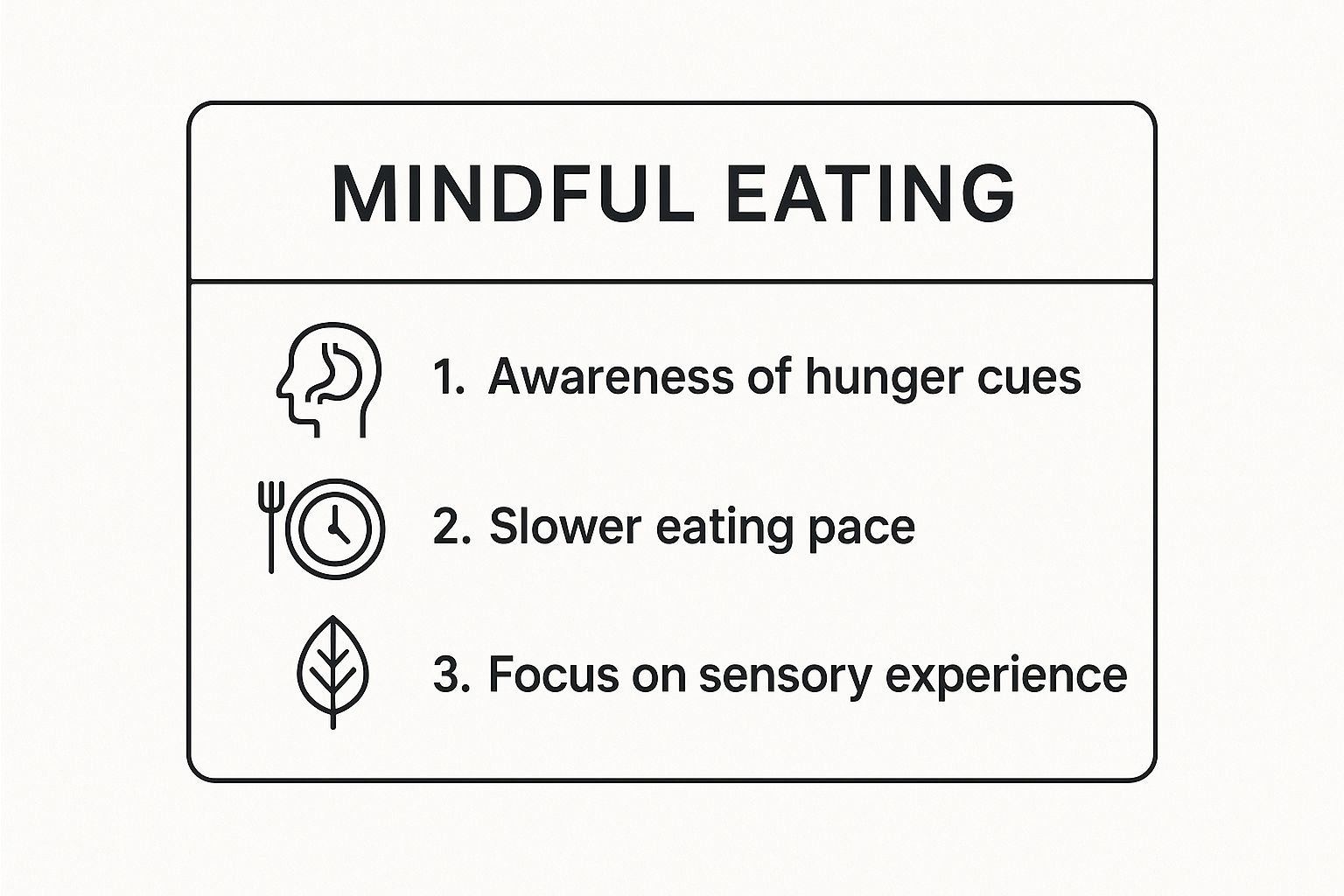
As you can see, becoming aware of your body's signals, slowing down your eating pace, and focusing on the sensory details are the keys to unlocking a more conscious and satisfying eating experience.
Mindful Eating vs Mindless Eating At a Glance
To really bring the concept home, let’s put the two approaches side-by-side. This quick comparison clearly lays out the fundamental differences, helping you see just how distinct they are.
| Aspect | Mindful Eating | Mindless Eating |
|---|---|---|
| Pace | Slow and deliberate, savouring each bite | Fast and rushed, often swallowing food quickly |
| Attention | Focused on the food and sensory experience | Distracted by screens, work, or conversation |
| Motivation | Eating in response to physical hunger cues | Eating out of habit, boredom, or emotion |
| Awareness | Conscious of fullness and stops when satisfied | Often overeats, ignoring the body’s signals |
| Outcome | Leads to greater satisfaction and enjoyment | Can result in guilt, discomfort, and indigestion |
Seeing them laid out like this makes it easy to spot where our own habits might fall and highlights the simple shifts that can make a huge difference.
Understanding the Core Principles of Mindful Eating

To really get to grips with what is mindful eating, it helps to think of it less as a strict diet and more as a set of gentle guidelines. These ideas are all about bringing awareness back to your meals, helping you tap into your body's natural wisdom. It’s a skill you build over time, not a test you have to pass every time you sit down to eat.
So, let's move past the theory and look at the pillars that hold this practice up. Each one gives you a new way to think about your relationship with food, shifting your focus from what’s happening around you to what’s happening within you.
Honouring Your Body’s Natural Signals
At its core, mindful eating is about listening. Your body is always sending you messages about hunger and fullness, but our fast-paced lives make it all too easy to tune them out. The first step is learning to listen to that conversation again.
This means hitting pause before you grab a snack and asking a simple question: "Am I actually hungry?" Physical hunger usually creeps up slowly, while emotional hunger often hits you like a truck. As you eat, the goal is to notice those first gentle nudges of satisfaction and stop when you feel comfortably full, not completely stuffed.
By slowing down and checking in with your body, you can distinguish between true physical hunger and emotional cravings. This awareness helps you nourish your body appropriately and avoid overeating, which can lead to discomfort and guilt.
Engaging All Your Senses
Ever noticed how food just tastes better when you’re really paying attention? This principle is all about making your meal a full-sensory event. Instead of just tasting, you're encouraged to really see, smell, touch, and even hear your food. It’s the difference between mindlessly wolfing down a sandwich at your desk and savouring the vibrant colours, fresh aromas, and crisp textures of a salad.
When you bring all your senses to the table, you automatically slow down. This gives your brain the 20 minutes or so it needs to get the message that you’re full, which is a game-changer for preventing overeating. More importantly, it brings a genuine sense of pleasure and satisfaction back to your meals.
Acknowledging Your Triggers Without Judgement
Let's be honest—we don’t just eat when we're hungry. We eat when we're bored, stressed, sad, or even celebrating. Mindful eating asks you to look at these emotional triggers with curiosity, not criticism. The aim isn't to banish emotional eating forever but simply to notice when and why it’s happening.
The next time you feel an urge to eat, take a breath and ask yourself what you’re really feeling. That tiny pause creates just enough space to make a conscious choice. You might still decide to have that piece of chocolate, but you'll do it with awareness, and that’s a huge step toward a healthier relationship with food. It’s a far cry from restrictive diets; this approach is about self-awareness, not strict rules. For those exploring similar food philosophies, learning what is clean eating can offer another valuable perspective.
Cultivating Gratitude for Your Food
The final piece of the puzzle is about fostering a little appreciation for what’s on your plate. This can be as simple as taking a moment to think about the journey your food took to get to you—the farmer who grew the vegetables, the driver who delivered them, and the hands that prepared the meal. This small practice can shift your entire mindset from just consuming to truly appreciating.
This sense of gratitude makes the whole experience more meaningful and satisfying. It helps you value the nourishment your food provides, creating a positive and respectful foundation for your entire mindful eating journey.
Ready to see how this all comes together? Let's try a quick exercise:
- Select Your Food: Pick up a single piece of fruit, like a strawberry or a slice of apple.
- Observe: Before taking a bite, just look at it. Notice its unique colour, shape, and texture.
- Smell: Bring it close and take a deep breath. What scents do you notice?
- First Bite: Take one small bite and chew it slowly. Focus on the burst of flavour and the sound it makes.
- Pause: After you swallow, just sit for a moment. How does that one bite feel?
This simple act shows how these principles can turn something ordinary into a rich, mindful experience.
The Science-Backed Benefits of Mindful Eating

There’s a lot more to mindful eating than just feeling more connected to your food. It turns out that this simple practice comes with a whole host of tangible benefits, all backed by solid science. This isn't just about positive thinking; it’s about the powerful physiological and psychological shifts that happen when you slow down and simply pay attention.
When you bring this kind of awareness to the table, you’re giving your body and brain a chance to finally get on the same page. This alignment can do everything from improving digestion to completely reshaping your relationship with food. Let's take a closer look at what that means for you.
Enhancing Your Digestive Health
One of the first things people notice is a big improvement in their digestion. It makes sense, really. When you’re eating in a rush or feeling stressed, your body is in "fight-or-flight" mode, which pulls energy away from your digestive system. This often leads to that familiar bloating and discomfort we all know and hate.
By eating slowly and chewing your food properly, you give your digestive process a much-needed head start. Your saliva gets a chance to do its job, and your stomach receives clear signals to prepare for what's coming. Research has even shown that mindfulness techniques can help ease symptoms of conditions like Irritable Bowel Syndrome (IBS) by calming the nervous system and improving overall gut function.
The connection between our gut and our mind is a fascinating one. If you're keen to learn more, diving into resources on understanding the fascinating gut microbiota-brain axis can be a real eye-opener.
Fostering Sustainable Weight Management
For anyone tired of the endless cycle of restrictive diets, mindful eating is a breath of fresh air. It shifts the focus away from counting calories and instead encourages you to listen to what your body is actually telling you about hunger and fullness. This is the key to managing weight for good—it’s about building skills, not just following rules.
It takes your brain about 20 minutes to get the message that your stomach is full. When you eat slowly, you give it that time, which dramatically reduces the chances of overeating. You also start to learn the difference between true physical hunger and those emotional or boredom-driven cravings, empowering you to make choices that truly nourish your body without ever feeling deprived.
Research consistently shows that combining mindful eating with basic nutritional knowledge leads to far more sustainable weight management than traditional dieting alone. It works because it focuses on internal cues rather than external rules, helping people build habits that actually last.
Cultivating a Healthier Relationship with Food
Perhaps the most life-changing benefit is the way mindful eating can heal your psychological relationship with food. It’s a practice rooted in non-judgement, which helps to dismantle the guilt and anxiety that so many of us carry around mealtimes. It allows you to observe your own habits and emotional triggers with curiosity, not criticism.
This approach can be particularly powerful for anyone struggling with disordered eating patterns, like binge eating. By fostering self-awareness, you learn to respond to your body's needs with compassion. Food starts to transform from a source of conflict into what it should be: a source of both nourishment and genuine pleasure.
Here’s how it helps on a psychological level:
- Reduced Emotional Eating: You begin to spot your triggers—like stress, sadness, or boredom—and can find healthier ways to manage those feelings instead of turning to food.
- Increased Food Enjoyment: When you engage all your senses, meals become richer and more satisfying. This alone can curb cravings for less nutritious foods.
- Greater Self-Compassion: You learn to forgive yourself for making less-than-perfect food choices, breaking the cycle of guilt that often fuels more unhealthy habits.
Ultimately, by understanding what mindful eating is and putting its principles into practice, you give yourself the tools to build a balanced, joyful, and sustainable approach to your well-being that will last a lifetime.
How to Begin Your Mindful Eating Journey

Starting anything new can feel a bit overwhelming, but the real beauty of mindful eating is that it isn’t about perfection. It’s a journey of tuning back into yourself, and it all begins with a few small, simple steps. You don’t need to overhaul your entire life overnight. Just think of it as gently introducing moments of presence into your day.
The goal here is to build a healthier, more connected relationship with food, one meal at a time. This guide is your practical roadmap, full of low-commitment exercises you can try today to ease into the practice without feeling stressed.
Creating Your Mindful Eating Space
First things first: let's set the stage for success. Your environment plays a massive role in your ability to focus, and mealtimes are no exception. A couple of small tweaks can make a world of difference, shifting your attention away from the chaos and onto your plate.
It’s a bit like preparing a quiet space for meditation—you want to minimise the noise. This doesn't mean you need a complete kitchen makeover, just a conscious effort to create a calm atmosphere where you can properly focus on your meal.
Here are a few simple ways to create that distraction-free zone:
- Designate a Screen-Free Table: Make a simple rule: no phones, laptops, or TV during meals. This one change alone can dramatically increase your presence.
- Set the Table: Even if you're eating alone, the simple act of setting a place for yourself—with a placemat, cutlery, and a glass of water—signals that this is a dedicated, important time.
- Clear the Clutter: A tidy eating space helps create a clearer mind. Take a minute to clear away the mail, work papers, or other random items before you sit down.
These small actions send a powerful message to your brain: it's time to slow down and pay attention.
Practical First Steps to Try Today
Now that your space is ready, it's time to put mindfulness into practice. Remember, the key is to start small and be kind to yourself. Pick one or two of these exercises that feel doable and build from there.
The "One Mindful Meal a Day" challenge is a fantastic starting point. Instead of trying to be mindful at every single meal (which is a recipe for burnout!), just commit to one. It could be your morning coffee, your lunch break, or your evening dinner. This approach keeps the practice feeling achievable, rather than another thing to stress about.
A key part of this journey is recognising that mindful eating is not about restriction but about awareness. It’s about adding intention to your actions, not taking pleasure away from your food.
Here’s a simple checklist to guide you through your first mindful meal:
- Pre-Meal Body Scan: Before your first bite, close your eyes and take three deep breaths. Ask yourself, "On a scale of 1 to 10, how hungry am I?" This simple check-in helps you connect with your body's actual hunger cues.
- Engage Your Senses: Take a moment to really look at your food. Notice the colours, shapes, and textures. Then, breathe in its aroma. This simple act of observation brings you right into the present moment.
- Chew Slowly: Try to chew each bite more thoroughly than you normally would. Put your cutlery down between bites to give yourself a natural pause. This not only helps digestion but also gives your brain time to register that you're getting full.
- Listen to Your Body: Halfway through your meal, pause and check in with your hunger levels again. Are you starting to feel satisfied? Learning to pick up on these subtle signals is a core skill in mindful eating.
Navigating Common Hurdles
Life is busy. We get it. Integrating any new habit can be tricky, so it’s important to be realistic about the obstacles and have a few strategies up your sleeve.
A hectic schedule is a common one. If you’ve got a demanding job or family commitments, finding time for a slow, mindful meal can feel impossible. The solution isn't to force it, but to adapt. Even a five-minute mindful snack break—where you step away from your desk to focus solely on eating an apple—can be a powerful act of mindfulness.
Social eating is another challenge. Dinners with family and friends are often filled with conversation and distractions. Instead of aiming for perfect mindfulness, just focus on one small thing. You could, for instance, concentrate on savouring the first three bites of your meal before diving back into the conversation.
Making healthier food choices is another piece of the puzzle. Shockingly, surveys in Australia show that only about 6% of adults eat the recommended five serves of vegetables daily, with many people finding it hard to stick to healthy habits. Thankfully, there are tools to help. Learning how to read nutrition labels can empower you to make more informed choices at the supermarket. And as you get started, other practices like learning how to start journaling for self-discovery and mental clarity can really help you understand your relationship with food on a deeper level.
Overcoming Common Challenges and Misconceptions
Taking the first steps into mindful eating is a fantastic move, but let's be honest—like any new habit, it can feel a bit awkward at first. It’s easy to get bogged down by myths and misconceptions that make the whole thing seem far more complicated than it actually is.
So, let's clear the air and bust a few of the most common myths. Many people hear "mindful eating" and picture someone in a silent, hour-long meditation with a single raisin. Others assume it's just another diet dressed up in wellness language. By tackling these hurdles head-on, you'll see just how practical and freeing this practice can be in your real, everyday life.
Myth: Mindful Eating Takes Too Much Time
This is probably the biggest roadblock for most people. The idea of spending 30 minutes slowly savouring every single bite sounds lovely in theory, but who has that kind of time during a busy workday?
Reality: Mindful eating isn't about adding hours to your day; it’s about adding awareness to the moments you already have. You don’t have to do it for every meal. Just start small. Try dedicating the first five minutes of your lunch to being fully present, or choose one meal a week—like a Saturday morning breakfast—to practice without distractions. It’s a flexible approach, not a rigid set of rules.
You can even be mindful with a quick snack. Instead of mindlessly scrolling on your phone while you eat an apple, take just two minutes to focus on its crisp texture and sweet taste. That's a powerful moment of mindfulness, and it takes virtually no extra time at all.
Myth: It’s Just Another Diet in Disguise
With the constant barrage of new diets, it’s completely understandable to be sceptical. When you hear phrases like "listen to your body," it can sound suspiciously like another way to restrict what you eat to hit a certain weight.
Reality: This is where the biggest difference lies. Diets are built on external rules—counting calories, cutting out entire food groups, or sticking to a rigid meal plan someone else created. Mindful eating is the complete opposite. It’s about turning your attention inward to honour your body's internal cues for hunger, satisfaction, and fullness.
Mindful eating is fundamentally anti-diet. The goal is to repair your relationship with food by stripping away judgment and guilt, not by piling on more rules. It’s about learning to trust your body's innate wisdom instead of an external plan.
This is more important than ever. Projections show that by 2030, Australian consumption of discretionary foods like sugary drinks could rise by 18%, while our fruit intake might drop by nearly 10%. Building a mindful connection with your food is a direct way to counter these trends. You can read the full CSIRO report on these concerning Australian dietary trends.
Tackling Real-World Scenarios
Knowing the theory is one thing, but what about putting it into practice when you're out with friends or trying to manage a chaotic family dinner? It's easier than you think.
Here’s how to handle a few common situations:
- At a Social Dinner: You don't need to tune out your friends to be mindful. Just try this: for the first three bites of your meal, focus completely on the flavours and textures. Savour them, and then gently rejoin the conversation.
- In a Busy Restaurant: A bustling environment, like our own Absolute Cravings cafe, can actually be part of the experience. Instead of seeing the noise as a distraction, notice the sounds and smells around you. Let them add another layer to your sensory awareness of the meal.
- During Family Meals: Family dinners can be gloriously loud and messy. The goal isn't to create a silent, meditative space. Simply try putting your cutlery down between bites while you listen to a story, or make a point of chewing thoroughly before you jump into the conversation.
A little preparation goes a long way, especially when life gets hectic. Having delicious, nourishing meals ready to go makes it so much easier to eat mindfully. For some great tips, check out our guide on how to meal prep effectively. Armed with these simple, realistic strategies, you can bring mindfulness to the table, no matter what your day looks like.
Have a Few Questions About Mindful Eating?
As you start to explore what mindful eating is all about, it’s completely normal to have some questions. It's a very personal practice, and feeling clear on the details is the best way to get started with confidence. We get asked a lot about this, so we've put together some straightforward answers to the most common queries.
How Is Mindful Eating Different From Intuitive Eating?
This is a brilliant question. The two ideas are often spoken about in the same breath because they share a similar heart – both are about rejecting diet culture and listening to your body. But they do have slightly different focuses.
Here’s a simple way to think about it: mindful eating is the how of eating, while intuitive eating is the why. Mindful eating is all about being completely present with your food—truly tasting the flavours, noticing the textures, and tuning into your body's signals right there in the moment. Intuitive eating is a bigger picture. It includes mindfulness, but it also encompasses things like honouring your hunger, making peace with all types of food, and treating your body with respect, no matter its shape or size.
In short, mindful eating is a core skill that fits inside the broader philosophy of intuitive eating. You can absolutely practise mindful eating on its own, but it’s pretty much impossible to eat intuitively without being mindful.
Can I Practise Mindful Eating if I Have Dietary Restrictions?
Yes, absolutely. Mindful eating isn't about what you eat, but how you eat. This makes it incredibly flexible. It doesn't matter if you have allergies, follow a specific diet for medical reasons, or have cultural or ethical food guidelines—the principles of mindfulness will still apply.
In fact, the practice can be a really powerful tool when you're navigating specific dietary needs. It helps you tune into how different foods actually make your body feel, which can guide you toward better choices within your restrictions. It also encourages a sense of curiosity and self-compassion, which can be a huge help when dealing with the frustrations that sometimes come with food limitations.
How Long Does It Take to Notice the Benefits?
There's really no set timeline here; everyone's journey is different. Some people feel small changes almost straight away, like noticing they enjoy their food more or feel less bloated after eating. For others, it might take a few weeks to start unravelling years of habits around emotional eating or eating while distracted.
The real secret is consistency, not perfection. You'll likely notice the smaller things first:
- Within days: You might find you have a much greater appreciation for the taste and texture of your food.
- Within weeks: You could feel more in sync with your body’s hunger and fullness signals, which often leads to less overeating.
- Within months: Many people experience a real drop in food-related guilt and develop a much more peaceful, positive relationship with their meals.
Just remember, it's a practice of self-awareness. The benefits will show up in their own time as you continue to approach your meals with a bit of patience and curiosity.
What Are Simple Ways to Introduce Mindful Eating to Children?
Teaching kids about mindful eating can help them build a healthy relationship with food that lasts a lifetime. The key is to keep it light, fun, and completely free of pressure. Forget formal lessons; just weave it into your everyday routines.
A great place to start is by encouraging them to use all their senses. Ask playful questions like, "What sound does that crunchy carrot make?" or "What does this orange smell like?" You can also be a powerful role model by simply putting your phone away at the table and talking about how yummy the food is. When you create a positive, present mealtime environment, you’re teaching the core ideas of mindful eating without them even realising it.
Ready to enjoy a truly mindful meal in a beautiful setting? Visit us at Absolute Cravings, right next to the Palmetum Gardens, or explore our delicious and healthy menu online for delivery. Find your new favourite meal today.