

Ever feel a bit lost staring at a wall of boxes in the cereal aisle? With all the bright packaging and bold health claims, it’s easy to get overwhelmed. Learning to decipher a food label is one of the most practical skills you can have for navigating a modern supermarket. It’s your ticket to moving beyond generic ‘eat healthy’ advice and gaining the confidence to make choices that truly line up with your personal health goals.
This skill lets you see right past the clever marketing slogans and understand a product's real nutritional value. Think of it as your personal map to understanding what’s really in your food.
Why Reading Food Labels Is a Supermarket Superpower
Decoding the Australian Food Package
Here in Australia, every packaged food product gives you a few key tools to work with. To get the full story, you really need to look at three main components, with each one telling a different part of the tale:
- The Nutrition Information Panel (NIP): This is that detailed grid of numbers you see on the back. It breaks down everything from energy (kilojoules) and protein to fats and sodium.
- The Ingredients List: I often find this is the most revealing part. It shows you what the product is actually made of, listed in order from the largest amount to the smallest.
- The Health Star Rating: This is the quick, at-a-glance guide on the front of the pack. It's designed to make comparing similar products a bit faster when you're in a hurry.
Getting your head around these labels is a massive part of any https://www.absolutecravings.com.au/tag/healthy-eating/. The system we have today has evolved over time, driven by a big push for greater consumer awareness. Back in 2009, the National Preventative Health Taskforce recommended front-of-pack labelling to help Aussies make healthier choices on the fly.
By mastering these three elements, you can take back control of your grocery shop. You'll be able to quickly spot products that are hiding a lot of sugar or salt and choose options that genuinely nourish your body. It turns a confusing task into an empowering habit.
Breaking Down the Nutrition Information Panel
Alright, let's get into the numbers. This is where the real story of your food is told, but don't worry, I'll make it simple. The Nutrition Information Panel (NIP) is that grid on the back of the pack that lays out a product's nutritional DNA. It's your single best tool for cutting through the flashy marketing claims to see what you're really putting in your body.
First, let's get a bird's-eye view of how to approach a typical label, from the energy it provides to the macros and how it all fits into your day.
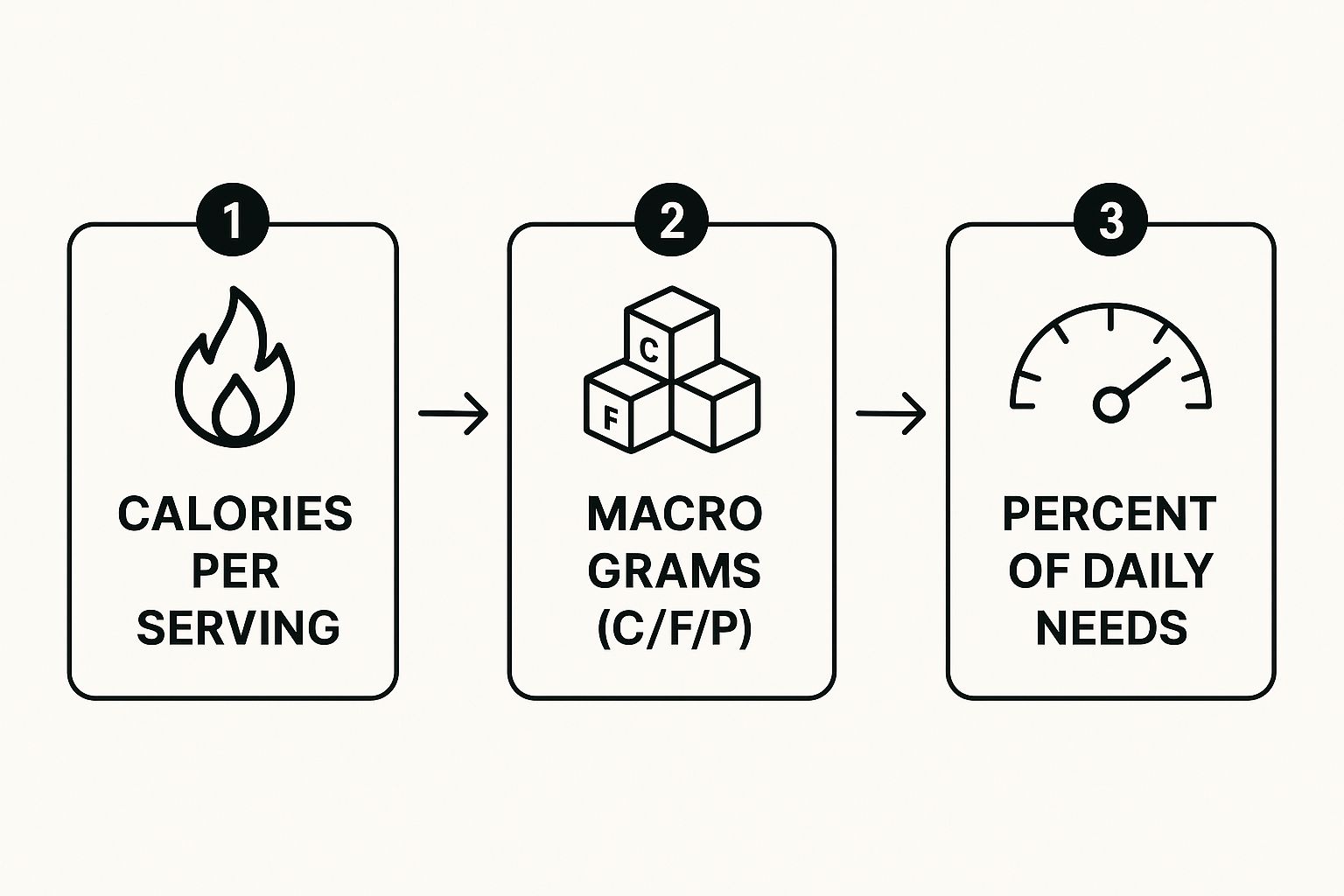
This gives you a clear path: start with the energy, dig into the nutrient breakdown, and then see how it stacks up against your daily needs. It’s a complete picture.
The Serving Size Deception
The very first thing you need to eyeball is the serving size. This one number dictates everything else on the panel, and believe me, manufacturers can be pretty sneaky here. A small bag of chips might look innocent enough until you realise the packet actually contains three servings, not one.
Always ask yourself, "Is this serving size realistic for how much I'm actually going to eat?" If the answer is no, you’ll need to do some quick mental maths to figure out the true nutritional cost of your portion.
Per Serve vs Per 100g
Every Australian NIP has two columns that matter: ‘Per Serve’ and ‘Per 100g’ (or 100mL for liquids). The ‘Per Serve’ column is based on the manufacturer's suggested portion—which, as we've just seen, can be a bit of a trap.
The ‘Per 100g’ column is your secret weapon. It standardises the information, giving you a fair, apples-to-apples way to compare any two similar products, no matter what their serving sizes are.
This is the absolute key to becoming a savvy shopper. By ignoring the serving sizes and jumping straight to the ‘Per 100g’ columns, you can instantly tell which product is genuinely higher in sugar, sodium, or saturated fat.
To see this in action, let's compare two breakfast cereals. At a glance, they might seem similar, but the 'Per 100g' column reveals the truth.
Comparing Two Breakfast Cereals Using the Per 100g Column
| Nutrient (per 100g) | Cereal A ('Fruity Puffs') | Cereal B ('Oat Bran Flakes') |
|---|---|---|
| Energy (kJ) | 1650 kJ | 1450 kJ |
| Protein | 5.2g | 12.5g |
| Fat, Total | 3.1g | 6.8g |
| Saturated | 0.8g | 1.2g |
| Carbohydrate | 85.3g | 58.5g |
| Sugars | 42.5g | 15.1g |
| Fibre | 2.5g | 14.8g |
| Sodium | 380mg | 295mg |
Side-by-side, it's clear. Cereal A is packed with nearly three times the sugar and has very little fibre, while Cereal B offers more protein and a huge fibre boost, making it the far superior choice for a nutritious start to the day.
Understanding the Key Nutrients
The panel lists a handful of key nutrients. Here’s a quick rundown of what to focus on:
- Energy (kJ): This is the fuel your body gets from the food. If you're managing your weight, keeping an eye on energy-dense foods is a smart move.
- Protein: Essential for building and repairing tissues, from your muscles to your hair. Higher protein foods also tend to keep you feeling fuller for longer.
- Fat (Total and Saturated): Total fat is the overall amount, but pay close attention to saturated fat. A high intake is linked to health problems, so aim for products that are low in saturated fat per 100g.
- Carbohydrate (Total and Sugars): This includes starches, fibre, and sugars. The 'sugars' number lumps natural and added sugars together, so you'll need to glance at the ingredients list to see if sugar is one of the main components.
- Sodium: This is basically salt, and processed foods are often loaded with it. Try to choose products with less than 400mg per 100g, and if you can find options under 120mg per 100g, even better.
The introduction of these panels was a huge step forward for consumer health in Australia. Over the years, our NIPs have evolved to become a powerful tool, providing mandatory information to help us all become more aware of what we eat.
Of course, just understanding the parts is one thing; using them effectively is another. For example, a well-designed ultimate nutrition plan for athletes depends entirely on being able to interpret these labels to hit very specific macro and micronutrient targets.
Reading the Ingredients List Like a Pro
While the nutrition panel gives you the hard numbers, the ingredients list is where you discover a food's true character. I always think of it as the most honest part of the packaging, telling you what something is actually made from, beyond the kilojoules and grams of fat. This is where you switch from a numbers game to a quality check.
The most powerful rule to remember is this: ingredients are always listed in descending order by weight. Simple, but incredibly revealing. The first ingredient is the most prominent, and the last is the least.
So, if "oats" is the first thing you see on your muesli bar's list, you're off to a good start. But if "glucose syrup" or "sugar" is at the top? You know you're essentially buying a lolly bar, no matter what healthy claims are splashed across the front of the box.
The First Three Ingredients Rule
Here’s a fantastic shortcut I use for a quick quality assessment: just focus on the first three ingredients. These make up the bulk of the product, so they give you a brilliant snapshot of its nutritional foundation.
If those first three are whole foods like wholegrain wheat, brown rice, or a lean protein, it's probably a solid choice.
On the flip side, if sugar, refined flours, or various oils are hogging the top spots, that’s a big red flag. This simple check helps you quickly sift through the options without getting bogged down in every tiny detail.
Uncovering Hidden Sugars and Fats
Food manufacturers have become masters of disguise, especially when it comes to sugar. It can hide under all sorts of different names, making it tricky to spot if you're only looking for the word "sugar."
Keep an eye out for these common aliases:
- Syrups: corn syrup, high-fructose corn syrup, golden syrup, rice malt syrup
- Words ending in "-ose": dextrose, fructose, glucose, lactose, maltose, sucrose
- Other names: fruit juice concentrate, maltodextrin, cane juice, agave nectar
Similarly, watch out for "partially hydrogenated oils," which are a source of unhealthy trans fats. Spotting these helps you understand the true nature of what you’re eating. Funnily enough, these skills are transferable! To really master the art, you can even apply them to your pet's food by learning how to compare cat food ingredients and decode labels for their optimal nutrition.
Key Takeaway: The ingredients list shows you the quality of the food. If the first few ingredients are wholesome and recognisable, you're on the right track. If they're a collection of sugars, refined grains, and additives, it might be best to put it back on the shelf.
Decoding Additives and Allergens
Towards the end of the list, you'll find additives like preservatives, colours, and flavours. In Australia, these are often listed by their code numbers (e.g., Colour (102)). While most are considered safe, some people simply prefer to avoid them where they can.
The good news is that by law, major allergens must be clearly declared. You'll often see them in bold text within the list (e.g., wheat, milk, soy) or in a separate "Contains" statement below it. This makes it much easier to identify them, turning a label check into a critical safety step for many families.
Navigating the Health Star Rating System
Those stars on the front of the pack can be a handy shortcut, but they certainly don't tell the whole story. The Health Star Rating (HSR) system is designed to give you a quick, at-a-glance comparison of similar packaged foods, making it easier to pick a healthier option when you're in a rush.
The system is pretty clever, really. It uses an algorithm that balances the "good stuff" against the "not-so-good stuff." It tallies up beneficial components like fibre, protein, and the amount of fruit, veggies, nuts, and legumes. Then, it weighs these against what are called 'risk nutrients'—think saturated fat, sugar, and sodium—to come up with a score from half a star all the way up to five.
Using the HSR System Smartly
The real magic of the Health Star Rating comes alive when you're making a direct comparison. It’s your best friend when you’re standing in the aisle, trying to decide between two brands of yoghurt, a couple of muesli bars, or different frozen meals.
If one yoghurt has 4.5 stars and the one next to it has 3 stars, the HSR is telling you the 4.5-star option is likely lower in things like sugar or saturated fat, or perhaps higher in protein. It cuts through all the marketing noise and gives you a simple, effective tie-breaker.
The HSR is a fantastic tool for comparing like-for-like products. Use it to quickly decide between two similar items, but don't rely on it as the only measure of a food's overall healthiness.
Despite how useful it can be, the HSR isn't mandatory. A 2019 look at its usage found that only 41% of eligible products carried the rating. This shows its adoption has been a bit selective, often favouring products that already have higher ratings. While it might become mandatory if uptake doesn't hit 70% by 2025, for now, you just won't see it on a lot of products. You can discover more insights about the state of Health Star Rating adoption in Australia if you're curious.
Recognising the Blind Spots
It’s crucial to understand what the Health Star Rating doesn't do. The system has some pretty significant blind spots that can be misleading if you take the stars as gospel.
One of the biggest limitations is that the HSR only compares products within the same category. This can lead to some really strange outcomes:
- A heavily processed snack food might get a high rating simply because it’s slightly "better" than other processed snacks in its category.
- A bag of plain, unsalted nuts might get a lower rating than a diet soft drink because of its natural (and healthy!) fat content.
This is exactly why you can't just rely on the stars. The best approach is to use the HSR as your starting point, then flip the pack over and take a quick look at the ingredients list. Whole foods like fresh fruit, vegetables, and lean meats—which often have no label at all—are almost always a healthier choice than a highly processed five-star ready meal.
Use the stars as a guide, not an absolute rule.
Your Supermarket Game Plan for Healthier Choices
Alright, you’ve got the theory down on how to read nutrition labels. Now it's time to take that knowledge and put it into action where it really counts: the supermarket aisle. This is where you turn information into habit, transforming what can feel like a chore into a quick, confident, and healthy shopping routine.
Think of your next grocery trip as a practice run. You don’t need to get bogged down analysing every single package. Instead, a few smart shortcuts are all you need to make better choices without the headache.
The Five-Second Scan
When you're standing in front of the shelf, trying to decide between two similar products—say, two jars of pasta sauce or two boxes of crackers—the five-second scan is your best friend. It’s my go-to trick for a quick, no-fuss comparison.
Just pick up both items and flip them over to the Nutrition Information Panel. Let your eyes jump straight to the ‘Per 100g’ column. This gives you a true side-by-side comparison.
In just a few seconds, you can check:
- Sugars: Which one is lower?
- Sodium: Is one option way higher than the other? A good rule of thumb is to aim for less than 400mg per 100g.
- Saturated Fat: Can you spot the one with less saturated fat?
This simple check cuts right through the clever marketing claims on the front of the box and shows you the real numbers.
Focus on the First Three Ingredients
Here’s another incredibly powerful shortcut: ignore the massive ingredients list for a moment and just read the first three. Ingredients are listed by weight, so these three make up the biggest portion of what you’re about to eat.
What do you see? Are they whole foods you actually recognise, like wholegrain oats, tomatoes, or chicken? Or are they different forms of sugar, refined flour, or mysterious vegetable oils? This one little check will give you a surprisingly clear picture of a product's overall quality.
Ignore the buzzwords on the front of the pack. Claims like "all natural," "light," or "real fruit" are often just marketing fluff. The real truth is always found in the nutrition panel and the ingredients list on the back.
Shop the Perimeter First
One of the easiest ways to build a healthier trolley has nothing to do with labels at all. Get into the habit of shopping the perimeter of the supermarket first. This is where you’ll almost always find the fresh, whole foods—fruits, vegetables, lean meats, fish, and dairy.
These items rarely have complicated labels because they are the ingredients. By filling your trolley with these foods first, you naturally prioritise nutrient-dense, less-processed options. It’s a simple strategy that also makes planning your meals much easier. And if you need a little help turning all that fresh produce into amazing meals, our guide on how to meal prep is a great place to start. Making small shifts like this in your shopping routine is a fantastic way to build a healthier pantry and, ultimately, a healthier you.
Got Questions About Nutrition Labels? We've Got Answers
Even after you get the hang of reading nutrition labels, it's completely normal for a few tricky questions to pop up while you're standing in the middle of a supermarket aisle. It happens to all of us!
Let's walk through some of the most common queries. Think of this as your go-to guide for those confusing moments that can make you second-guess what you’re putting in your trolley.
Sugars vs. Added Sugars: What’s the Difference?
Right now, Australian food labels lump all sugars together under one heading: ‘Sugars’. This total includes both the good stuff, like naturally occurring sugars from fruit (fructose) or milk (lactose), and the added sugars that are thrown in during manufacturing.
This makes it tough to tell if a product's sweetness comes from whole ingredients or just empty kilojoules.
Your best bet? Put on your detective hat and scan the ingredients list. If you see sugar, glucose syrup, or other sweeteners listed near the top, you can be sure it’s packed with added sugar. There's a push to get 'added sugars' listed separately, which would be a massive help for everyone trying to make healthier choices.
Is a Five-Star Health Rating Always Best?
Not necessarily. The Health Star Rating system is a fantastic tool when you're making quick comparisons between very similar packaged items. For instance, if you’re choosing between two muesli bars, picking the one with more stars is generally a smart move.
But it definitely has its limits. A processed ready-meal might score four stars, while a simple bag of almonds only gets three because of their natural fat content—even though the nuts are a far less processed, whole-food option.
The Health Star Rating is a useful guide for packaged goods, but don't stop there. Always pair it with a quick check of the ingredients list to get the full picture of the food's quality.
What’s a Good Rule for Sodium Levels?
Sodium can be incredibly sneaky, especially in processed foods like sauces, bread, and tinned soups. The easiest way to keep tabs on it is by using the ‘Per 100g’ column on the nutrition panel for a fair, apples-to-apples comparison.
Here are a couple of simple benchmarks to keep in mind:
- Low Sodium: Anything under 120mg of sodium per 100g is considered low. This is a great target to aim for.
- High Sodium: A product with more than 400mg of sodium per 100g is high in sodium. It’s wise to limit these foods where you can.
Just checking the sodium on these common pantry items is a simple but effective way to lower your overall intake and support better heart health. Using these skills helps you put together nourishing meals, and you can find more inspiration in our guide to healthy family meal ideas.
At Absolute Cravings, we believe that healthy food should be delicious and easy. Visit us in Townsville or check out our menu online at https://www.absolutecravings.com.au to discover your next favourite healthy meal.