Think of a coffee grind size chart as your roadmap to a brilliant cup of coffee. It’s all about matching the coarseness of your coffee grounds to your chosen brewing method. If you get this right, you're in control of the flavour. Get it wrong, and you're heading for a weak, sour, or horribly bitter brew.
Your Quick Reference Grind Size Guide
Getting your daily coffee just right all comes down to the link between the size of the coffee grounds and the final taste in your cup. It's a simple concept, really. If your grounds are too coarse, water zips through them way too fast, leading to under-extraction. The result? A sour, weak, and underwhelming coffee.
On the other hand, if the grounds are too fine, the water struggles to get through at all. This is called over-extraction, and it’s the culprit behind that bitter, harsh taste that can ruin a perfectly good morning. The sweet spot is finding that perfect balance where the water has just enough time to pull out all the delicious flavours from the coffee.
This infographic is a fantastic starting point, giving you a visual cue for the main grind categories.
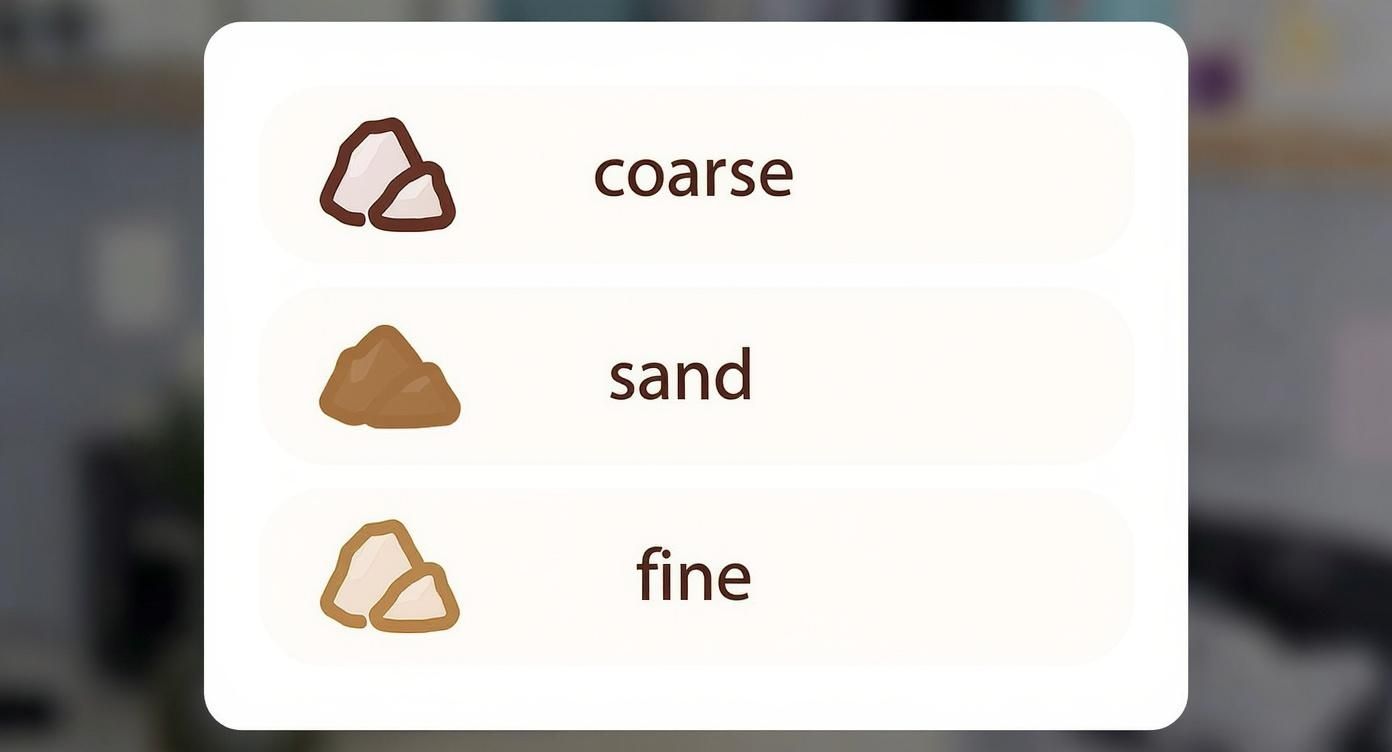
As you can see, coarse grinds have the chunky texture of rock salt, medium grinds are more like sand, and fine grinds feel almost like flour. Every brewing method, from a trusty French press to a high-tech espresso machine, has its own ideal spot on this spectrum. For an even deeper dive, this ultimate coffee grind size guide is another excellent resource.
Brew Method and Grind Size Matcher
To make things even easier, we've put together this handy table. It's a quick lookup guide to match your favourite brew method with its ideal grind size, what it should look like, and how long the magic should take.
| Grind Size Category | Visual Comparison | Popular Brewing Methods | Typical Extraction Time |
|---|---|---|---|
| Extra Coarse | Peppercorns | Cold Brew, Cowboy Coffee | 12-24 hours |
| Coarse | Rock Salt | French Press, Percolator, Cupping | 4-5 minutes |
| Medium-Coarse | Rough Sand | Chemex, Clever Dripper | 3-4 minutes |
| Medium | Regular Sand | Drip Coffee Makers, Siphon, AeroPress (longer steep) | 2-3 minutes |
| Medium-Fine | Table Salt | V60, Kalita Wave, AeroPress (shorter steep) | 2-3 minutes |
| Fine | Fine Sugar | Espresso, Moka Pot | 20-30 seconds |
| Extra Fine | Flour / Powder | Turkish Coffee | 1-2 minutes |
Think of this table as your starting block. The exact grind will always vary slightly depending on the specific beans you're using, your grinder, and your personal taste, but this will get you incredibly close to a perfect brew every time.
By using a coffee grind chart as your guide, you create a solid foundation for consistency. From there, it's all about making small tweaks to nail the perfect flavour for your palate. For more insider tips on levelling up your home coffee game, check out our advice on https://www.absolutecravings.com.au/tag/how-to-make-barista-coffee/. This guide will be your go-to reference for a consistently delicious cup, day after day.
Why Grind Size Determines Coffee Flavour
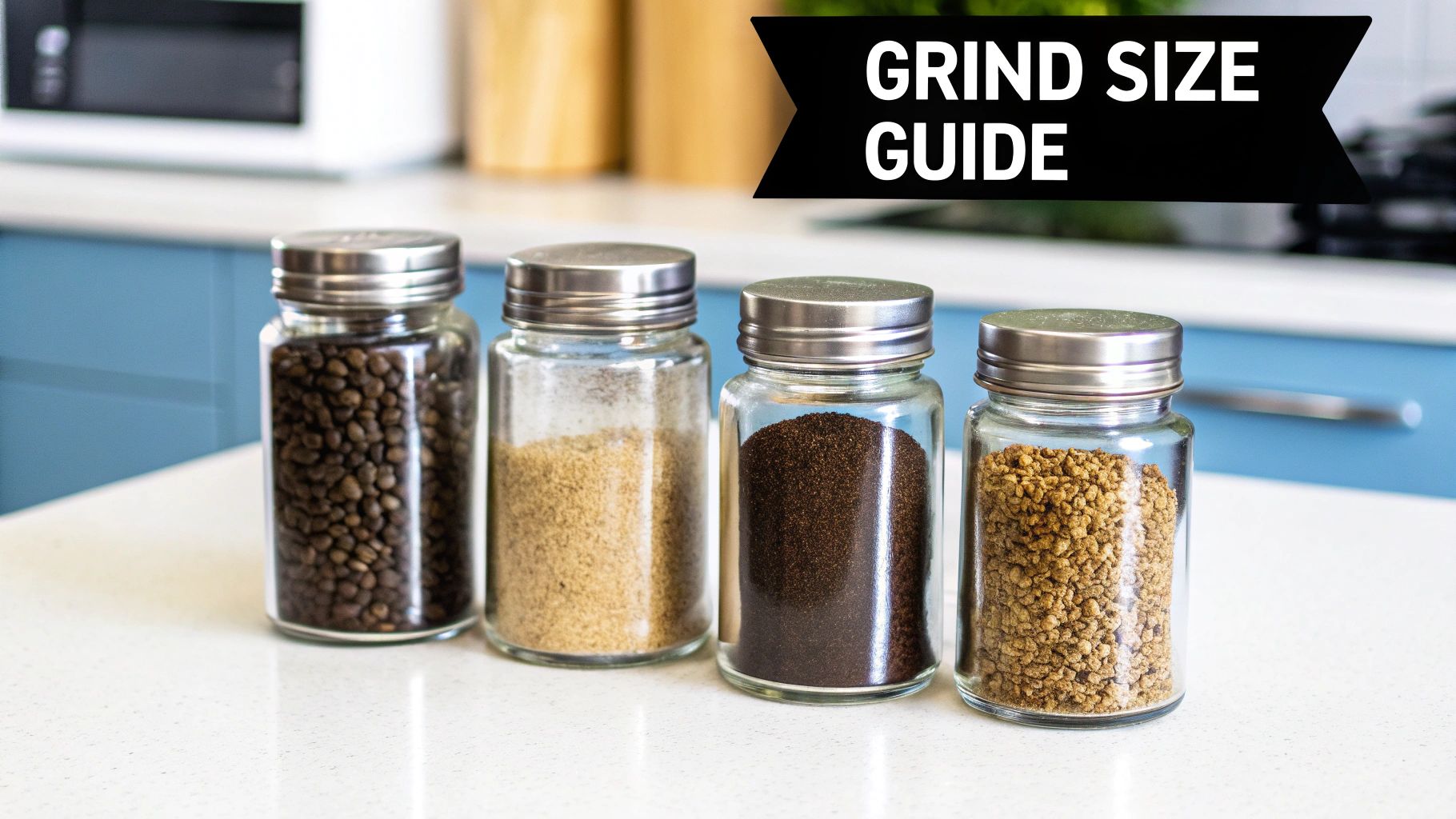
The real secret to unlocking incredible coffee flavour isn’t some fancy technique—it all comes down to extraction. Think of grinding coffee as getting it ready for brewing. The size of those little grounds directly controls how much surface area is exposed to hot water, and that dictates how quickly all the good stuff gets pulled out.
A good way to picture this is to imagine dissolving a big sugar cube versus a spoonful of fine sugar. The fine sugar disappears almost instantly because the water can get to so much more of its surface area all at once. Coffee is exactly the same. Finer grounds mean more surface area, which leads to a faster extraction. Coarser grounds have less surface area, slowing the whole process down.
This relationship between surface area and extraction time is precisely why every single entry on a coffee grind size chart matters so much. Every brewing method has its own ideal contact time, and your grind size is the main tool you have to nail that target.
The Two Extremes of Extraction
When your grind size and brew time just don't match up, you'll end up on one of two pretty unpleasant ends of the flavour spectrum. Getting your head around these will help you troubleshoot any brew that goes wrong.
-
Under-extraction: This is what happens when your grind is too coarse for how long you're brewing. Water just rushes through the grounds too quickly, and it doesn't have a chance to pull out enough of the coffee's delicious compounds. The result? A cup that tastes disappointingly sour, weak, and acidic.
-
Over-extraction: This is the opposite problem, and it's caused by a grind that’s too fine. The water hangs around for too long, pulling out not just the lovely flavours but all the unwanted, harsh compounds as well. This leaves you with a brew that is bitter, astringent, and tastes a bit hollow.
The goal is always to find that "sweet spot" right in the middle. A perfectly balanced extraction gives you a rich, complex, and sweet cup where the unique flavour notes of the beans can really sing.
Hitting this balance is what we call "dialing in." It’s that hands-on process of making tiny adjustments to your grind to steer away from sourness or bitterness until the flavour is just right. Of course, choosing the right beans is the first step—if you’re making espresso, you can learn more about the best coffee beans for espresso to get started with a quality foundation. From there, your grinder becomes your most powerful tool for chasing that perfect cup.
A Detailed Breakdown of Every Grind Size
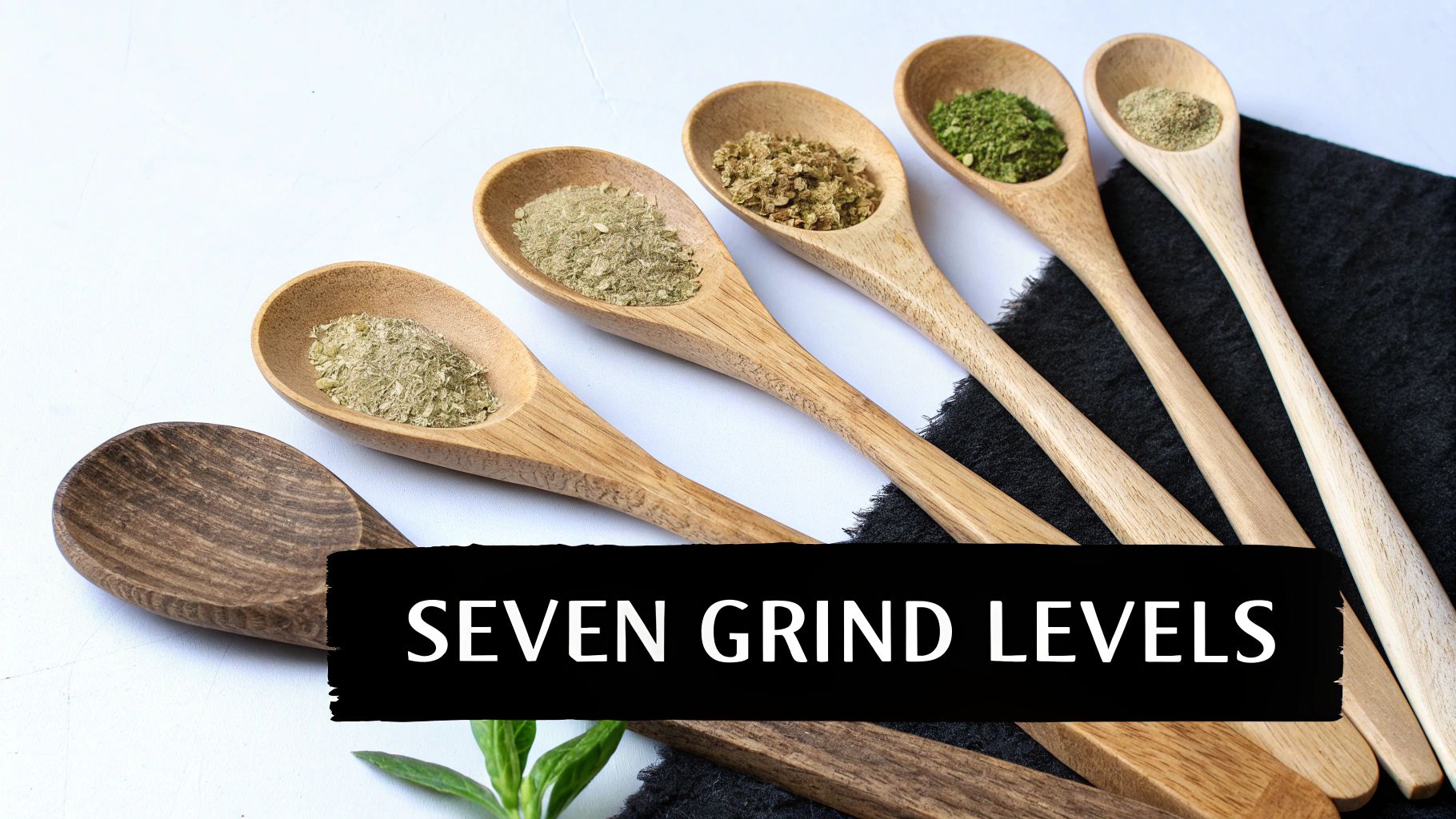
Let's move past the quick-glance charts and really get into the nitty-gritty of the seven key grind sizes. Think of this as the 'why' behind the what. Each level is distinct for a reason, designed to work with the physics of a particular brewing method. Understanding how the size of your coffee grounds interacts with water is the real secret to moving from just following a recipe to truly mastering your brew.
This deep dive will give you the confidence to dial in the perfect setting for any coffee maker you own. We'll explore how particle size, water flow, and extraction time all dance together to create the flavour profile you're chasing.
Extra Coarse Grind
Picture really chunky sea salt or cracked peppercorns. This is the big stuff. We're talking visibly hefty particles of coffee, which means they have a very low surface area. Because of this, they need a long time hanging out with water to properly extract all that delicious flavour.
- Best For: Cold Brew, Cowboy Coffee.
- Why It Works: For a brew like cold brew that steeps for a leisurely 12-24 hours, an extra coarse grind is absolutely non-negotiable. It allows for a slow, gentle extraction that coaxes out the sweet, smooth compounds without pulling in the harsh, bitter acids. Try a finer grind here and you'll end up with a cloudy, over-extracted mess. If you're curious to learn more about this smooth brewing style, you can discover all the health benefits of cold brew coffee in our dedicated guide.
Coarse Grind
A small step down from extra coarse, this grind feels like chunky rock salt. You can still easily see the individual particles, and they feel substantial between your fingers. This is your go-to for any full immersion brewing where the coffee grounds and water get to mingle for several minutes.
- Best For: French Press, Percolators, Coffee Cupping.
- Why It Works: The classic 4-5 minute steep time for a French press demands a coarse grind to stop it from becoming bitter and over-extracted. It also plays a practical role, ensuring the metal filter can easily press the grounds to the bottom, leaving you with a clean cup that isn't full of gritty sediment.
Medium-Coarse to Medium-Fine Grinds
This is where most of us live in our day-to-day coffee brewing. It’s a bit of a spectrum, ranging from the texture of rough sand all the way to something closer to table salt. These middle-of-the-road grinds are perfect for drip and pour-over methods, where water is pulled by gravity through a bed of coffee.
- Medium-Coarse: This is the sweet spot for brewers like the Chemex. Its famously thick paper filter slows things down, so a slightly coarser grind helps keep the water flowing at the right pace for a balanced cup.
- Medium: Your classic, all-purpose setting for most automatic drip coffee machines. It hits the perfect balance for a standard 2-3 minute brew cycle, making it the workhorse of kitchen coffee.
- Medium-Fine: Perfect for the more hands-on pour-over drippers like the Hario V60 or Kalita Wave. These brewers need a finer grind to give you more control over the water flow, helping you achieve a clean and complex extraction in that same 2-3 minute window.
Fine and Extra Fine Grinds
Now we're getting to the bottom of the scale, where the grinds are incredibly small and feel like fine sugar or even flour. These settings are reserved for specific brewing methods that rely on pressure or need an extremely fast, intense extraction.
Getting the grind right here is absolutely critical. For espresso, the ideal grind usually falls somewhere between 180 and 380 microns—a tiny range! This precision is vital because espresso machines force hot water through the coffee puck under intense pressure. Being even slightly off can completely ruin a shot.
- Fine (Espresso): This is what you need for Espresso and Moka Pots. The huge surface area of the fine grounds allows for a complete, balanced extraction in just 20-30 seconds.
- Extra Fine (Turkish): This powder-like consistency is essential for traditional Turkish coffee. The grounds are so fine that they are actually consumed as part of the beverage, settling at the bottom of the cup.
To help you visualise all this, we've put together a handy table that breaks down each category with more detail.
Detailed Grind Size Specifications and Brewing Applications
This table serves as your quick-reference guide, tying together the visual and textural cues of each grind size with its ideal brewing partner and the science behind why it works.
| Grind Size | Description (Appearance & Feel) | Best For (Brewing Methods) | Why It Works |
|---|---|---|---|
| Extra Coarse | Looks like cracked peppercorns; very chunky. | Cold Brew, Cowboy Coffee. | The huge particles need very long contact time (12-24 hours) for a slow, low-acid extraction. |
| Coarse | Feels like chunky sea salt or rock salt. | French Press, Percolators, Cupping. | Ideal for full immersion brews (4-5 mins); prevents over-extraction and keeps sediment out. |
| Medium-Coarse | Similar to rough sand; feels gritty. | Chemex, Clever Dripper, Cafe Solo. | Balances flow rate for brewers with thicker filters or longer steep times. |
| Medium | Feels like regular sand. | Drip Coffee Makers, Siphon Brewers. | The perfect middle-ground for automated brewers with a typical 2-3 minute cycle. |
| Medium-Fine | Texture of table salt; slightly smoother than sand. | Pour-Overs (V60, Kalita Wave), Aeropress. | Offers more resistance to control water flow for manual, nuanced extractions. |
| Fine | Finer than table salt, like fine sugar. | Espresso, Moka Pot, Aeropress (short brew). | Massive surface area allows for full extraction under pressure in just 20-30 seconds. |
| Extra Fine | Feels like powder or flour; clumps together. | Turkish Coffee. | Creates the thick body needed as the grounds are suspended and consumed in the drink. |
Hopefully, this table makes it even clearer how each grind size has a specific job to do. Finding the right one isn't just a suggestion—it's the foundation of a great cup of coffee.
How to Choose the Right Coffee Grinder
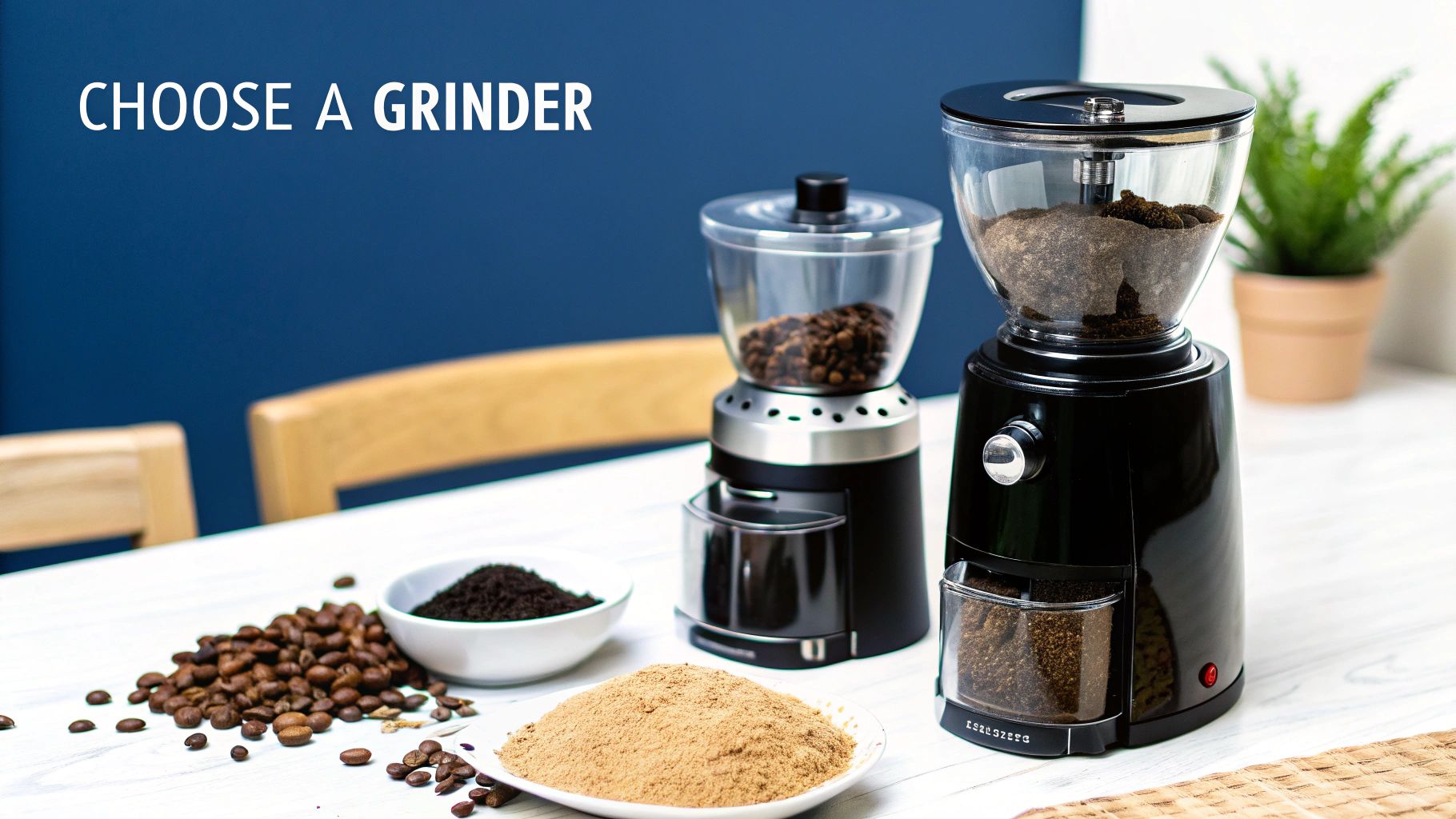
A coffee grind size chart is an incredible tool, but it's only as good as the grinder you’re using. Truth be told, your grinder is probably the single most important piece of gear in your coffee-making arsenal. When you start looking, you'll find the choice really boils down to two main types: burr grinders and blade grinders.
Blade grinders work a bit like a blender, using a spinning blade to smash and chop beans into pieces. They’re usually cheap, but the result is a chaotic mix of large chunks (we call them 'boulders') and fine dust ('fines'). That kind of inconsistency makes a balanced extraction almost impossible, leaving you with a brew that tastes both sour and bitter at the same time.
For anyone who wants real control over their coffee, burr grinders are the superior choice. They operate with two revolving abrasive surfaces—the burrs—that crush beans into a consistent, uniform size. It’s this consistency that unlocks the clean, clear flavours we’re all chasing and allows you to properly follow a grind chart.
Burr Grinders vs. Blade Grinders
Understanding the basic mechanics of each is key to making the right call for your coffee goals. Here’s a quick breakdown of how they stack up against each other:
| Feature | Burr Grinder | Blade Grinder |
|---|---|---|
| Grind Method | Crushes beans uniformly between two burrs. | Chops beans randomly with a spinning blade. |
| Consistency | Very High. Produces even particle sizes. | Very Low. Creates a mix of dust and chunks. |
| Control | Excellent. Allows for precise adjustments. | Poor. Grind size is based on time, not setting. |
| Heat | Minimal, preserving the coffee's flavour. | High, can scorch the beans and alter taste. |
| Best For | Anyone serious about coffee quality. | Basic use where consistency is not a priority. |
Key Factors to Consider
Once you've settled on getting a burr grinder, there are a few other things to think about. When building out your coffee setup, getting the right equipment is everything. For a more detailed look at what you might need, this coffee shop equipment checklist offers some great insights.
Think about whether you’d prefer a manual or electric model. Manual grinders are fantastic—they’re portable, offer amazing control, and are much easier on the wallet. Electric models, on the other hand, bring speed and convenience that are hard to beat for a daily brewing routine.
You'll also want to look at the adjustment mechanism. Stepped grinders have a limited number of grind settings you click between, which makes them really straightforward and great for beginners. Stepless grinders offer an infinite number of micro-adjustments between the main settings, giving you the ultimate level of control needed for dialling in that perfect espresso shot. Your final choice will hinge on your budget, your preferred brewing methods, and just how deep down the rabbit hole of precision you want to go.
How Grinder Technology Affects Your Coffee
When you get serious about coffee, you quickly learn it's not just about burrs versus blades. The motor whirring away inside your grinder plays a massive role in what ends up in your cup. Technical stuff like motor speed, measured in RPM (revolutions per minute), has a direct impact on how consistent your grind is and how much heat you're creating.
Going faster isn't always better. Sure, a high-speed grinder might get the job done quickly, but it often comes with a trade-off. High RPMs can generate more fines—those tiny, dust-like coffee particles that clog up your brew and lead to a muddy, over-extracted flavour. On top of that, all that speed creates heat, which can ever so slightly cook the grounds before they even see water, killing off the delicate aromatic notes that make your coffee special.
The Role of Grinder Speed and Power
The balance between a grinder’s RPM and the quality of the grind is something cafes and home enthusiasts across Australia really need to think about. Our 50 Hz mains electricity frequency means grinder motors here spin at a slightly different speed compared to places with 60 Hz power. While cranking up the RPM might seem like a good way to get a finer grind, it can actually throw off your dose accuracy and make your extraction less efficient.
For those of us in Australia, that local 50 Hz frequency can be a hidden advantage, often leading to better consistency and more precise dosing. If you're keen to go down the rabbit hole, there are some great insights on how grinder RPM affects coffee extraction.
Key Takeaway: Slower, more controlled grinding almost always gives you a more uniform particle size and creates less heat. This is exactly what you want to preserve the coffee's original flavour. It's why top-tier grinders are built for torque, not just raw speed.
Understanding the Australian Nuance
This whole power frequency thing might sound like a minor detail, but for Australian coffee lovers, it really matters. It means a grinder bought locally is already optimised for our electrical system. It's more likely to run a bit cooler and more consistently than a model you've imported that was built for a 60 Hz grid.
Ultimately, getting your head around these technical points explains why one grinder can produce a brilliant cup while another falls flat, even if they're both set to a similar point on a coffee grind size chart. It's always that magic combination of quality burrs, a gutsy motor, and controlled speed that lays the foundation for a truly perfect brew.
Right, so you've got a fancy coffee grind size chart pinned to your wall. That's a great start, but the real magic happens when you move from theory to practice. This is where the term "dialing in" comes into its own. It’s all about making tiny, careful adjustments to your grinder based purely on taste, transforming a decent coffee into an unforgettable one.
Think of dialing in as a conversation with your coffee beans. The goal is to find that elusive "sweet spot" for any given bean and brew method, steering clear of sour, under-extracted brews and their bitter, over-extracted cousins. It’s less about following rigid rules and more about trusting your palate.
Finding Your Starting Point
Every single grinder has its own personality, so the first step is always to figure out its unique "zero point." This gives you a reliable baseline you can come back to time and time again.
- Clear the Hopper: First things first, make sure there are no beans hanging around in the grinder.
- Purge the Grinder: Pop it on for a few seconds to get rid of any grounds left behind from your last brew.
- Find the Zero Point: With the motor off, start tightening the burrs (moving to a finer setting). Go slowly until you feel them just begin to touch. You might hear a little chirp. That’s it – you’ve found your zero.
- Back It Off: Immediately loosen the setting by one or two notches. You don't want the burrs grinding against each other. From this point, you can confidently adjust coarser for whatever you're brewing.
Here's a pro tip to live by: always adjust your grind size while the grinder is running, especially when you're going finer. It stops beans from getting jammed between the burrs, which can put a lot of stress on the motor.
Adjusting by Taste: An Espresso Example
There’s no better training ground for dialing in than espresso; the feedback is instant and obvious. Let’s imagine your first shot of the day gushes out in under 20 seconds and tastes unpleasantly sour.
- The Problem: Your grind is way too coarse. The water is blasting through the coffee puck so quickly it doesn't have a chance to pull out all those lovely sweet flavours.
- The Solution: Make a small tweak to a finer setting on your grinder. This adds more resistance, slows the water down, and gives it the time it needs to do its job properly.
On the flip side, what if your shot chokes the machine, taking more than 35 seconds to pull, and the result is intensely bitter? That means your grind is too fine. The fix is simple: make a small adjustment towards a coarser setting. By tasting and tweaking like this, you’ll quickly land on that perfectly balanced shot that’s rich, sweet, and exactly what you were hoping for.
Common Questions About Coffee Grind Size
Even with a detailed coffee grind size chart in front of you, a few practical questions always seem to come up when you're actually at the grinder. We get it. Let's run through some of the most common queries to help you nail your technique and troubleshoot on the fly.
Does Grind Size Change for Different Beans?
Yes, it absolutely does. This is a detail many people miss. Darker roasts, for example, are more brittle and soluble after spending longer in the roaster. You'll often need a slightly coarser grind for them compared to a light roast, otherwise, you risk a bitter, over-extracted flavour.
The freshness of the bean matters, too. Older beans that have lost some of their vibrancy might need a finer grind setting to help you extract what's left of their character.
Is It Better to Grind Coffee Fresh?
Without a doubt. Grinding your beans just before you brew is probably the single biggest improvement you can make to your coffee at home. Pre-ground coffee starts to lose its beautiful, delicate aromatic compounds almost immediately through oxidation.
Freshly ground beans, on the other hand, deliver a punch of flavour and a depth that pre-ground coffee just can't compete with. It's a game-changer.
One of the most common mistakes we see is people thinking they can get a consistent grind from a blade grinder. The random chopping action creates a messy mix of large "boulders" and fine "fines," which leads to a muddled taste that is somehow both sour and bitter at the same time. A quality burr grinder is absolutely essential for uniformity.
What Happens If My Grind Is Too Coarse or Fine?
Getting the grind size wrong has a direct and immediate impact on the taste in your cup. It all comes down to extraction.
Here’s a simple breakdown:
- Too Coarse: Water zips through the coffee grounds way too quickly, leading to under-extraction. Your coffee will taste disappointingly weak, sour, and overly acidic.
- Too Fine: The coffee bed becomes too dense, and water struggles to pass through, causing over-extraction. This results in a brew that tastes bitter, harsh, and hollow.
At Absolute Cravings, we believe that a truly great coffee experience starts with getting these fundamentals right. Drop by our Townsville cafe to taste the difference that precision and passion make, or feel free to check out our full menu online at https://www.absolutecravings.com.au.


